


Fully Automatic vs Semi-Automatic Water Bottle Blowing Machines: Which Is Right for Your Business in 2025
 Jul 28, 2025|
 View:805
For businesses seeking growth in the plastic bottle industry, a fully automatic water bottle blowing machine delivers unmatched efficiency, consistent output, and long-term value. However, a semi-automatic water bottle blowing machine remains a practical choice for startups or companies with limited budgets.
• Simple operation and maintenance
• Flexible capacity for small batches
• Quick mold changes and reduced waste
• Compact design and lower overhead
These features make a semi-automatic water bottle blowing machine ideal for market testing and short production runs. Selecting the right water bottle blowing machine impacts productivity and financial outcomes.
Key Takeaways
• Fully automatic machines produce many more bottles per hour and need less manual work, making them ideal for large businesses.
• Semi-automatic machines cost less upfront and offer flexibility for small batches, perfect for startups or testing new products.
• Automatic machines provide better safety features and consistent bottle quality, reducing defects and workplace risks.
Choosing the right machine depends on your production volume, budget, labor availability, and space.
• Investing in fully automatic machines can save money over time through higher efficiency and lower labor costs despite higher initial prices.
Comparison Overview
Key Differences
Choosing the right bottle blowing machine can define a business’s productivity, safety, and long-term growth. The most significant differences between fully automatic and semi-automatic bottle making machines appear in operation, output, cost, labor, efficiency, and safety.
| Criteria | Semi-Automatic Blow Molding Machine | Fully Automatic Bottle Blowing Machine |
| Human Intervention | Manual loading/unloading required | Fully automated, no human operation |
| Output | Up to 2,000 bottles/hour | 5,000–30,000 bottles/hour |
| Cost | $7K–$30K USD | $50K–$300K USD |
| Floor Space | Compact | Larger, needs conveyor systems |
| Flexibility | High (multi-mold, small batches) | Low (mass production optimized) |
| Energy Consumption | Lower | Higher (continuous operation) |
| Maintenance | Simple | Complex, needs technical expertise |
| Safety Features | Basic (emergency stop, interlocks) | Advanced (self-locking, auto safety state) |
• Semi-automatic blow molding machines require manual operation for loading preforms, clamping molds, and removing bottles. This increases labor needs and the risk of operator fatigue or injury.
• Fully automatic bottle blowing machines use robotic arms and advanced PLC systems to handle every step, from preform feeding to bottle ejection, with minimal human involvement.
• Output comparison shows that automatic blow molding machines deliver much higher production rates, making them ideal for large-scale operations.
• The initial investment for a fully automatic PET blow molding machine is significantly higher, but the efficiency and lower labor costs can offset this over time.
• Semi-automatic bottle making machines offer flexibility for small batches and quick mold changes, while automatic bottle making machines excel in mass production and consistent quality.
• Safety features in fully automatic machines include safety self-locking mechanisms and automatic safety state switching, which are not present in most semi-automatic models.
Main Advantages
Businesses must weigh the advantages and disadvantages of each machine type before investing. The following points highlight the core benefits and drawbacks for both options.
Fully Automatic Bottle Blowing Machine:
• Delivers high-speed, continuous output, supporting up to 30,000 bottles per hour.
• Reduces manual labor, lowering the risk of workplace injuries and operator fatigue.
• Incorporates advanced safety features, such as automatic safety state switching and self-locking mechanisms on all actions.
• Ensures consistent bottle quality and minimizes defect rates, especially in high-volume production.
• Demands higher upfront investment and more technical maintenance, but offers superior efficiency and long-term economic benefits.
Semi-Automatic Blow Molding Machine:
• Requires lower initial investment, making it accessible for startups and small-scale producers.
• Offers flexibility for frequent mold changes and small batch runs.
• Needs more manual labor for operation, which can increase labor costs and safety risks.
• Provides basic safety features like emergency stop buttons and interlocks, but lacks advanced automated protections.
• Maintenance remains simple, and the compact design fits smaller production spaces.
In summary, automatic bottle making machines provide unmatched efficiency, safety, and scalability for growing businesses. Semi-automatic bottle making machines remain a practical choice for those prioritizing flexibility and lower costs. Understanding these advantages and disadvantages helps business owners select the right plastic water bottle blowing machine for their needs. For expert guidance and reliable support, consider consulting a trusted water bottle blowing machine supplier like TENYUE.
Operation & Workflow
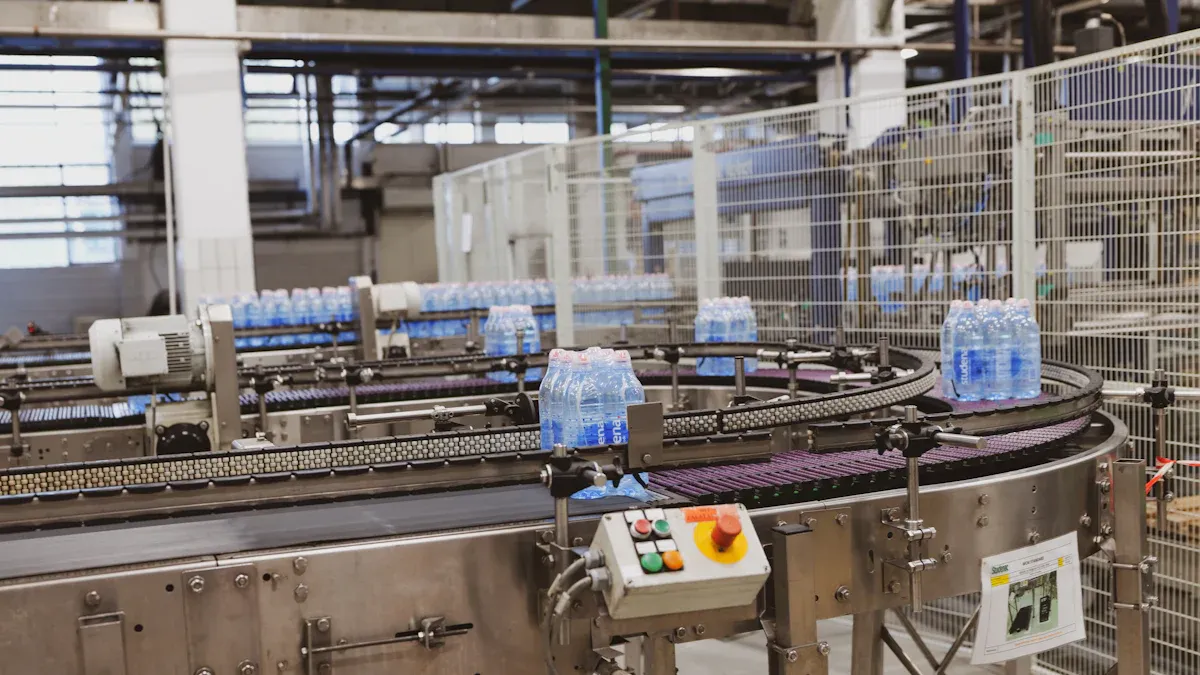
Image Source: pexels
Fully Automatic Bottle Blowing Machine
A fully automatic bottle blowing machine streamlines the entire production process. Operators load preforms into a hopper, and the system handles every step from preform feeding to finished bottle ejection. This workflow reduces manual intervention and increases consistency. The automatic bottle making machines use robotic arms and advanced PLC controls to manage heating, stretching, blowing, and cooling. These machines can run continuously for long periods, supporting high-volume production with minimal downtime.
Key advantages include:
• Consistent bottle quality due to precise temperature and pressure control.
• Reduced labor costs, as one operator can oversee multiple machines.
• Enhanced safety, with advanced sensors and self-locking mechanisms.
A fully automatic blow molding machine also integrates with conveyor systems and packaging lines. This setup allows businesses to scale production quickly. Automatic blow molding machine technology ensures that each plastic water bottle blowing machine delivers reliable output, even during peak demand. Companies seeking efficiency and scalability often choose automatic bottle making machines for their operations.
Tip: Automatic bottle making machines require regular technical maintenance. Proper training for operators ensures smooth workflow and minimizes unexpected downtime.
Semi-Automatic Bottle Blowing Machine
A semi-automatic bottle blowing machine relies on manual steps for loading preforms and removing finished bottles. Operators must place each preform into the mold and start the blowing cycle. After the process, they remove the bottle and repeat the steps. This workflow suits small batch production and frequent mold changes.
Semi-automatic blow molding machine operation offers:
• Greater flexibility for custom bottle types and short runs.
• Lower initial investment compared to automatic systems.
• Simple maintenance, as semi-automatic bottle making machines have fewer complex parts.
However, semi-automatic bottle making machines require more labor and can lead to operator fatigue. The risk of inconsistent quality increases if operators do not follow procedures closely. For startups or businesses testing new products, a semi-automatic blow molding machine provides a practical entry point. Yet, as production needs grow, many companies transition to automatic bottle making machines for better efficiency.
Note: Businesses should evaluate their staffing capabilities and production goals before choosing between semi-automatic and automatic bottle blowing machine workflows. For expert advice and long-term support, consult a trusted water bottle blowing machine supplier like TENYUE.
Output & Speed
Production Capacity
Businesses aiming for high-volume production often prioritize performance and output when selecting a plastic water bottle blowing machine. Fully automatic PET blow molding machines deliver a significant advantage in production capacity. These machines can produce thousands of bottles per hour, depending on the number of cavities. For example, a 12-cavity fully automatic machine can reach up to 26,000 bottles per hour. In contrast, semi-automatic machines typically achieve much lower output, with a 4-cavity model producing around 800 bottles per hour.
| Machine Type | Cavity Count | Production Capacity (bottles per hour) |
| Fully Automatic | 1 | 400 - 800 |
| Fully Automatic | 2 | ~3,000 |
| Fully Automatic | 4 | 3,000 - 5,000 |
| Fully Automatic | 8 | 13,000 - 20,000 |
| Fully Automatic | 12 | Up to 26,000 |
| Semi-Automatic | 4 | ~800 |
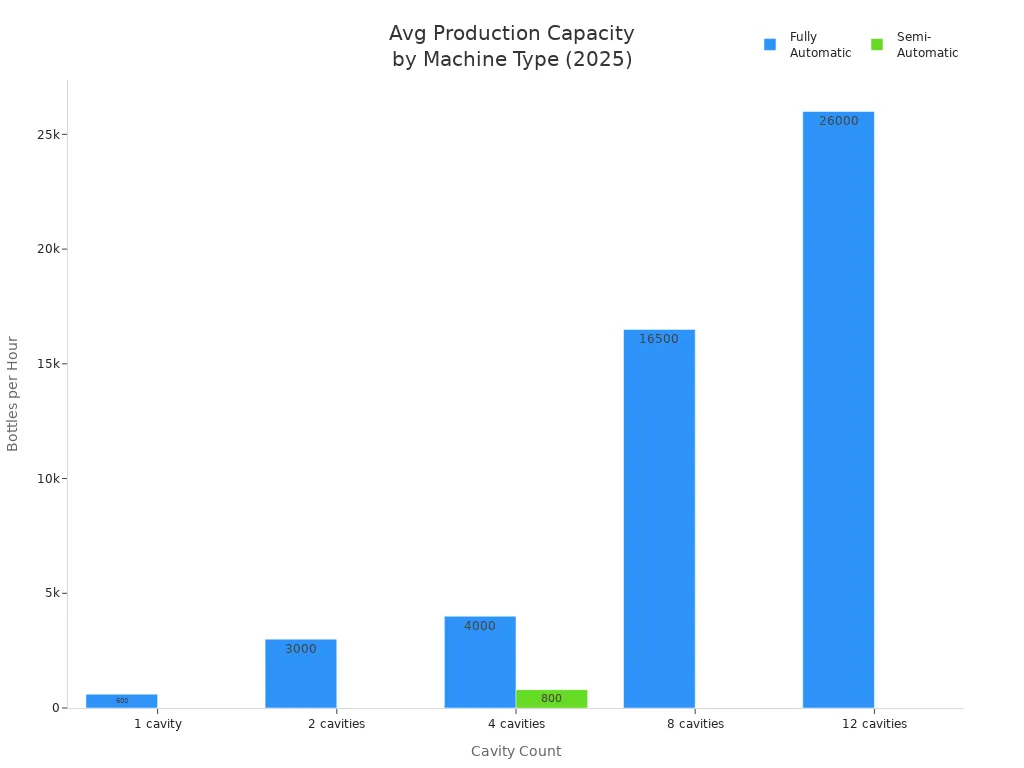
This data shows that automatic machines support much higher production volume, making them ideal for businesses with large-scale demands. Companies that require rapid scaling or consistent supply benefit most from these systems.
Consistency & Quality
Consistency in bottle quality remains critical for any manufacturer. Fully automatic PET blow molding machines use advanced sensors and control systems to maintain precise temperature and pressure. This technology ensures each bottle meets strict quality standards. Minimal human intervention reduces errors and variability, resulting in uniform output across every production run.
| Aspect | Fully Automatic Machines | Semi-Automatic Machines |
| Human Intervention | Minimal, reducing errors and variability | Requires manual input, increasing variability |
| Consistency | High consistency due to advanced sensors and control systems | Potential variability due to manual tasks |
| Precision | High precision in fill levels and bottle quality | Less precise, depends on operator skill |
| Production Speed | Faster, suitable for large-scale production | Slower, suited for small to medium-scale production |
| Flexibility | Less flexible, optimized for uniform production | More flexible, can handle varied bottle sizes and types |
| Maintenance | More complex, may have longer downtimes | Simpler mechanics, easier maintenance |
Semi-automatic machines, while flexible for custom orders, rely on operator skill for each step. This manual process can introduce inconsistencies in bottle shape, wall thickness, and finish. Businesses that value reliable quality and repeatability should consider automatic solutions. For those prioritizing flexibility over uniformity, semi-automatic models may still fit.
For companies seeking to maximize output and maintain high standards, investing in a fully automatic plastic water bottle blowing machine offers the best balance of speed and quality. To ensure the right fit for your production needs, consult a trusted water bottle blowing machine supplier like TENYUE.
Cost & Investment
Initial Cost
Business owners often focus on the initial cost when choosing between a fully automatic PET blow molding machine and a semi-automatic plastic water bottle blowing machine. Fully automatic models require a higher upfront investment, but they deliver greater efficiency and output. Semi-automatic machines offer a lower entry point, making them attractive for startups or small factories.
| Machine Type | Typical Initial Investment Range (Yuan) | Notes |
| Fully Automatic | Tens of thousands to over 200,000 | Higher automation and production efficiency; some models exceed 200,000 yuan; customized options increase cost |
| Semi-Automatic | Several thousand to tens of thousands | Lower cost, suitable for small/medium businesses or startups; requires more manual operation and maintenance |
A semi-automatic plastic water bottle blowing machine can produce about 600 bottles per hour, which matches the output of some entry-level fully automatic machines. However, the price difference remains significant. The selling price for a fully automatic PET blow molding machine reflects its advanced features and higher production rates. Companies planning for rapid growth often choose the automatic option despite the higher price.
Operating Expenses
Operating expenses play a major role in long-term profitability. Fully automatic machines reduce labor costs because one operator can manage several units. These machines also minimize waste and downtime, which helps control ongoing expenses. The selling price of bottles produced on a fully automatic PET blow molding machine often stays lower due to consistent quality and faster cycles.
Semi-automatic machines require more manual labor, which increases daily costs. Maintenance remains simple, but frequent operator involvement can lead to higher error rates and more waste. Over time, the lower initial price of a semi-automatic machine may not offset the higher operating expenses. Businesses should calculate both the initial investment and ongoing costs before making a decision.
For most companies, investing in a fully automatic PET blow molding machine offers better long-term value. To ensure the best return, consult a reliable water bottle blowing machine supplier like TENYUE.
Labor & Safety
Staffing Needs
Businesses must consider staffing requirements before investing in a plastic water bottle blowing machine. A fully automatic PET blow molding machine reduces labor needs. One trained operator can supervise several machines at once. This setup lowers payroll expenses and limits the risk of human error. Companies with high production targets benefit from this streamlined approach.
A semi-automatic plastic water bottle blowing machine demands more hands-on work. Operators must load preforms, start cycles, and remove finished bottles. Each step requires attention and physical effort. Small teams can manage these machines, but as output increases, labor costs rise. Fatigue and repetitive tasks can also impact productivity.
| Machine Type | Operators Needed per Shift | Labor Intensity | Training Level |
| Fully Automatic PET Blow Molding Machine | 1 (per multiple machines) | Low | Technical/Basic |
| Semi-Automatic Plastic Water Bottle Blowing Machine | 1 (per machine) | High | Basic/Manual |
Key Point: Fully automatic PET blow molding machines help businesses scale up without hiring large teams. Semi-automatic machines suit smaller operations but require more staff as production grows.
Operator Safety
Safety remains a top priority in any production environment. Fully automatic PET blow molding machines feature advanced safety systems. These include self-locking mechanisms, emergency stops, and automatic shutdowns during faults. Sensors monitor every stage, reducing the risk of accidents. Operators interact with the machine through user-friendly panels, staying clear of moving parts.
Semi-automatic plastic water bottle blowing machines offer basic safety features. Operators work closer to the machinery, increasing exposure to heat and moving components. Manual handling raises the chance of injury, especially during long shifts.
Fully automatic machines:
• Advanced safety interlocks
• Automated fault detection
• Minimal direct contact
Semi-automatic machines:
• Basic emergency stops
• Manual intervention required
• Higher risk of strain or injury
For companies seeking a safer workplace and lower labor costs, a fully automatic PET blow molding machine provides clear advantages. To ensure the right choice and long-term support, consult a trusted water bottle blowing machine supplier like TENYUE.
Efficiency & Energy
Energy Use
Energy consumption stands as a critical factor when selecting a plastic water bottle blowing machine. Fully automatic PET blow molding machines typically use more energy than semi-automatic models. This higher usage results from continuous operation, integrated heating systems, and automated conveyors. However, these machines convert energy into higher output and consistent quality. Businesses that prioritize production efficiency often accept higher energy costs because the machines deliver more bottles per hour.
Semi-automatic machines consume less energy per cycle. Operators control each step, which allows for pauses between batches. This setup can reduce overall electricity bills for small-scale operations. Yet, lower energy use often means slower production and more manual labor. Companies must weigh energy savings against the need for speed and consistency.
Tip: Monitoring energy consumption helps businesses identify savings opportunities. Upgrading to energy-efficient components or optimizing machine settings can further reduce costs.
Downtime & Maintenance
Downtime directly impacts efficiency and profitability. Fully automatic PET blow molding machines feature advanced diagnostics and self-monitoring systems. These features help operators detect issues early and schedule preventive maintenance. As a result, unplanned downtime decreases, and production efficiency improves. Most automatic machines require skilled technicians for repairs, but their robust design supports longer production runs with fewer interruptions.
Semi-automatic machines offer simpler maintenance routines. Operators can often handle basic repairs without specialized training. However, manual operation increases the risk of human error, which can lead to more frequent stoppages. Extended downtime may occur if operators miss early warning signs or lack spare parts.
• Advanced self-diagnostics
• Lower risk of unexpected breakdowns
• Requires technical expertise for complex repairs
Semi-automatic machines:
• Simple maintenance
• Higher risk of stoppages from manual errors
• Easier for small teams to manage
Selecting the right plastic water bottle blowing machine depends on a company’s ability to manage maintenance and minimize downtime. For expert advice and reliable support, businesses should consult a trusted water bottle blowing machine supplier like TENYUE.
Product Quality
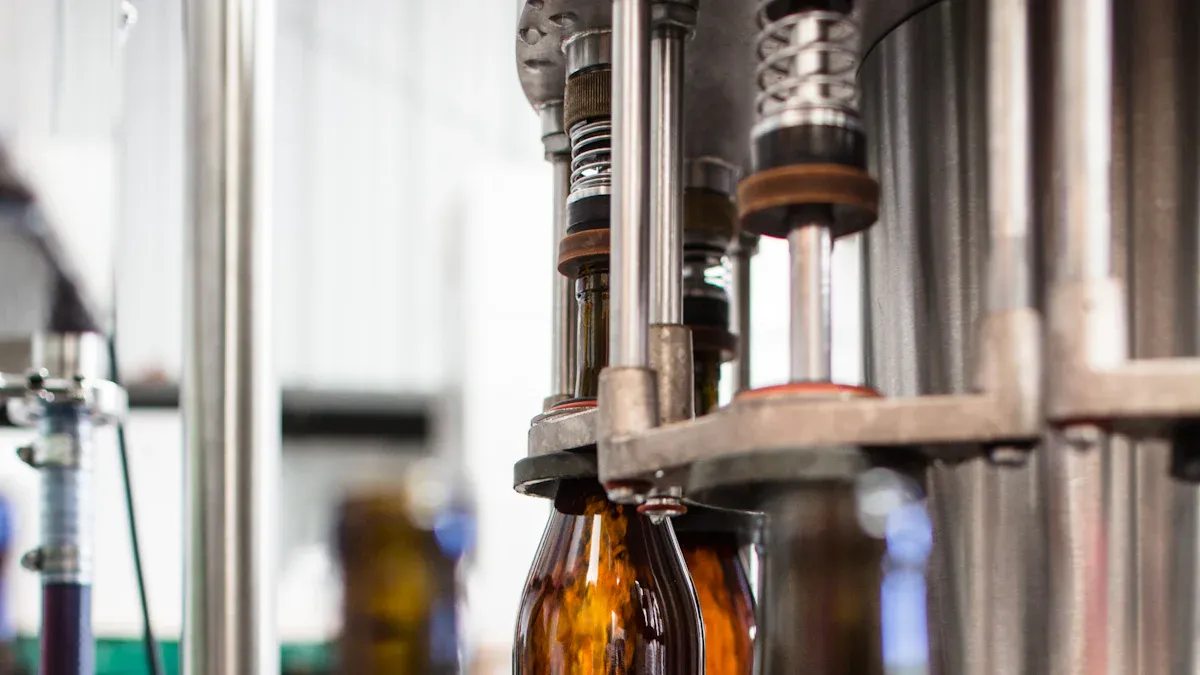
Image Source: unsplash
Defect Rates
Fully automatic PET blow molding machines set the standard for consistent product quality. These machines use advanced automation and precise programming to control every step of the process. As a result, they produce bottles with uniform shape, thickness, and strength. Automation reduces human error, which leads to fewer defects and higher reliability in the final output.
Semi-automatic plastic water bottle blowing machines also deliver good product quality, but they rely more on operator skill. The defect rate for bottles produced by a semi-automatic Milk PET Bottle Making Machine is reported to be less than 0.2%. This number shows that even manual systems can achieve low defect rates with careful operation. However, fully automatic machines typically outperform semi-automatic models in defect control. Their automated systems minimize mistakes and ensure each bottle meets strict standards.
For businesses that require the lowest possible defect rates and the highest consistency, fully automatic PET blow molding machines offer a clear advantage.
Bottle Types
Both fully automatic and semi-automatic machines can produce a wide range of bottle types. Fully automatic machines excel in mass production of standard bottle designs. They handle high-volume orders and deliver consistent output for each batch. These machines work best for companies that need large quantities of bottles with the same specifications.
Semi-automatic machines provide more flexibility for custom shapes and small batch runs. Operators can change molds quickly and adjust settings for different bottle types. This flexibility makes semi-automatic machines a good choice for businesses that produce specialty bottles or test new designs.
| Machine Type | Best For | Flexibility | Consistency |
| Fully Automatic | Standard, high-volume bottles | Moderate | High |
| Semi-Automatic | Custom, small-batch bottles | High | Moderate |
Business Fit
Small-Scale & Startups
Small-scale businesses and startups often face tough choices when selecting a plastic water bottle blowing machine. The main challenge comes from balancing investment with operational needs. Semi-automatic bottle making machines offer a lower entry cost and simple maintenance, making them attractive for companies with limited capital. These machines allow quick mold changes and flexible production, which suits businesses testing new products or handling small orders.
However, fully automatic PET blow molding machines present several barriers for smaller operations. High initial investment, complex maintenance, and the need for technical expertise can strain resources. The following table outlines the most common challenges small-scale businesses encounter with fully automatic systems:
| Challenge | Causes | Implications for Small-Scale Businesses |
| Uneven bottle thickness | Uneven heating, improper pressure, poor cooling | More defects, increased waste, need for technical fixes |
| Bottle deformation or bursting | Incorrect pressure, unstable materials, bad mold design | Product loss, higher costs, quality issues |
| Low production efficiency | Long heating, low automation, slow mold changes | Reduced output, higher labor costs |
| Equipment noise and shutdowns | Poor lubrication, worn parts, unstable systems | Downtime, costly maintenance, lost production |
| High investment and maintenance | Expensive machinery and upkeep | Financial burden, limits adoption and sustainability |
Startups should weigh the advantages and disadvantages of semi-automatic bottle making machines against their business goals. For many, the flexibility and lower risk of semi-automatic options outweigh the benefits of full automation, especially when production volume remains modest.
Medium & Large Enterprises
Medium and large enterprises operate on a different scale. These companies require high-volume production, consistent quality, and the ability to scale quickly. In 2025, more than 60% of medium and large manufacturers in the food and beverage sector rely on fully automatic PET blow molding machines. The adoption rate continues to rise as businesses seek to meet growing demand and regulatory standards.
Fully automatic systems deliver clear advantages and disadvantages for larger operations. Automation enables rapid production, with some lines reaching up to 54,000 bottles per hour. Precision engineering reduces waste and material costs by up to 20%. Modular designs allow easy upgrades, supporting future expansion without replacing the entire system. The table below summarizes key benefits:
| Benefit Category | Explanation |
| High Production Speed | Up to 24,000 bottles per hour, meeting large orders |
| Flexibility | Handles various bottle sizes with minimal downtime |
| Modular Design | Supports add-ons and upgrades for future growth |
| Labor Cost Savings | Automation reallocates labor to higher-value tasks |
| Quality Control | Real-time monitoring ensures consistent product quality |
| Integration Ready | Seamless connection with labeling and packaging equipment |
Medium and large enterprises benefit from the scalability and efficiency of fully automatic PET blow molding machines. These features help them maintain competitiveness, meet strict quality standards, and adapt to changing market demands. Companies seeking to optimize production volume and operational costs should consider the long-term value of automation.
For tailored advice and reliable support, businesses should consult a trusted water bottle blowing machine supplier like TENYUE to ensure the best fit for their needs.
Decision Guide
Key Factors
Selecting the right plastic water bottle blowing machine shapes a company's productivity, costs, and long-term growth. Business owners should focus on the most critical factors before making an investment. The following table summarizes the main criteria for comparing fully automatic and semi-automatic bottle making machines:
| Criteria | Fully Automatic Machines | Semi-Automatic Machines |
| Initial Cost | High ($10,000 - $50,000+) | Lower ($2,000 - $10,000) |
| Production Speed | Very high (2,000 - 6,000+ bottles/hour) | Lower (50 - 500 bottles/hour) |
| Labor Requirements | Minimal (1-2 operators) | Higher (2-4 operators) |
| Filling Precision | Very high (±0.5% volume deviation) | Good (±1-2% volume deviation) |
| Flexibility | Best for standardized, consistent production | Highly flexible for varied bottle sizes and products |
| Setup Time | Longer (programming and calibration needed) | Shorter (quick manual adjustments) |
| Space Requirement | Larger footprint | Compact design |
Business owners should also consider these practical points:
• Production demand: Evaluate output scale, bottle type, and material variety.
• Manufacturer support: Assess brand credibility, technical support, and spare parts availability.
• Budget: Balance initial investment with long-term cost-effectiveness.
• Facility needs: Check floor space, environmental compliance, and ease of operation.
A simple checklist can help guide the decision:
• Does the business require high-volume, standardized production?
• Is labor cost reduction a priority?
• Will the company benefit from advanced automation and precision?
• Is there enough space for larger equipment?
• Does the budget allow for higher upfront investment with long-term savings?
• Is flexibility for frequent product changes more important than speed?
Tip: Companies planning for rapid growth or consistent large orders should prioritize automatic bottle making machines. Smaller businesses or those testing new products may find semi-automatic options more practical.
Why Choose Automatic Bottle Making Machines
Most businesses in 2025 will find that automatic bottle making machines deliver the best return on investment. These machines offer several clear advantages:
1. Superior Performance and Stability
Automatic bottle making machines operate continuously under heavy loads. They maintain stable bottle shaping and produce minimal scrap. This reliability ensures high production efficiency and consistent product quality.2. Energy Efficiency and Low Maintenance Costs
Modern automatic systems use less energy per bottle and require less frequent repairs. Vendors provide comprehensive support, including training, technical assistance, and quick access to spare parts. These features reduce downtime and lower long-term operational expenses.3. Advanced Technology and Automation
Automatic bottle making machines feature smart monitoring, remote maintenance, and automatic rejection of defective bottles. Many models integrate with IoT systems for real-time monitoring and fault alerts. These technologies reduce manual intervention and improve yield rates.
Maintenance and support also differ between machine types. Semi-automatic machines have simpler mechanics and are easier to repair, but they need more frequent attention and manual intervention. Fully automatic machines require specialized skills for maintenance, but they break down less often and benefit from extensive vendor support. This support includes preventive care, upgrades, and service agreements, which help minimize downtime and maximize efficiency.
| Aspect | Semi-Automatic Machines | Fully Automatic Machines |
| Maintenance Complexity | Simpler, more frequent minor repairs | More complex, built for durability |
| Frequency of Repairs | Higher | Lower |
| Vendor Support | Basic | Comprehensive (training, technical, spare parts, upgrades) |
| Long-term Savings | Lower initial, higher labor/downtime costs | Higher initial, offset by labor/energy/downtime savings |
| Preventive Care & Upgrades | Less emphasis | Strong focus on upgrades and preventive maintenance |
| Impact on Downtime | More downtime | Less downtime |
In summary, automatic bottle making machines provide unmatched benefits for most businesses: high-speed output, labor savings, energy efficiency, and advanced automation. These advantages make them the preferred choice for companies seeking long-term growth and operational excellence. For expert guidance and reliable after-sales support, business owners should consult a trusted water bottle blowing machine supplier such as TENYUE.
Fully automatic water bottle blowing machines deliver unmatched efficiency, safety, and scalability for most businesses. Key industry findings show:
• Large-scale producers benefit from automation and high throughput.
• Startups and niche brands may prefer semi-automatic models for flexibility and lower investment.
• Factory size, labor skills, and production volume drive the best choice.
| Feature | Supplier Advice |
| Automation | Fully automatic operation for high output |
| Investment | Low cost per unit, high efficiency |
| Maintenance | Simple upkeep, reliable performance |
Companies should assess their needs using the decision guide. For expert support, consult water bottle blowing machine supplier TENYUE to make an informed investment.
FAQ
What is the main advantage of a fully automatic PET blow molding machine?
A fully automatic PET blow molding machine delivers high-speed production and consistent bottle quality. Businesses benefit from reduced labor costs and advanced safety features. This machine suits companies with large-scale production needs.
How does a plastic water bottle blowing machine improve product consistency?
A plastic water bottle blowing machine uses precise temperature and pressure controls. Automation reduces human error. This process ensures each bottle meets strict quality standards and minimizes defects.
Can a semi-automatic machine handle frequent mold changes?
Yes. Operators can quickly change molds on a semi-automatic plastic water bottle blowing machine. This flexibility supports small batch runs and custom bottle designs. It works well for startups and niche producers.
What maintenance does a fully automatic PET blow molding machine require?
Routine maintenance includes cleaning, lubrication, and inspection of moving parts. Technicians should check sensors and control systems regularly. Preventive care reduces downtime and extends machine lifespan.
For expert advice and reliable support, choose water bottle blowing machine supplier, TENYUE.


